




Few logos in the world carry the same instant recognition and emotional weight as Nike’s Swoosh. Today it stands for performance, ambition, and global athletic culture. But its origins are far more humble: a $35 design created for a small Oregon startup that was still trying to find its identity.
From Blue Ribbon Sports to a Brand in Search of Identity
Before becoming Nike, the company started in 1964 as Blue Ribbon Sports, founded by Phil Knight and Bill Bowerman. They initially sold Japanese running shoes, mainly from Onitsuka Tiger, rather than producing their own products.
By 1971, the business faced uncertainty as supplier contracts weakened. Knight realised the company needed its own shoes and a strong identity to survive.
That same year, the first Nike-named shoe, a $16.95 football boot, was released, but it still needed a distinct brand mark. This is where the Swoosh logo first entered the story.
The $35 Design That Changed Everything
Phil Knight hired design student Carolyn Davidson to create a simple mark suggesting movement for a shoe logo. She produced several ideas, including a curved checkmark symbolising speed and motion.
Knight wasn’t immediately impressed, and early reviewers admitted it was chosen as “the least awful” option. Still, its simplicity won out.
Davidson was paid just $35, and the design was quickly sent into production. The Swoosh was born, though it still didn’t have a name yet.
Early Days: Imperfect but Growing Strong
The first Nike shoes featuring the Swoosh were inconsistent in appearance. Depending on the factory or stitching method, the mark might look stretched, tight, or slightly distorted. Some even joked it looked like a “dead fish”.
But inconsistency didn’t stop momentum. The logo began appearing in real competitions, including the 1972 Boston Marathon, where top finishers wore Nike shoes. That visibility helped Nike establish credibility in the running world.
At this stage, Nike was still evolving from Blue Ribbon Sports into what would become Nike, Inc., and the Swoosh was slowly becoming its visual identity.
Experimentation, Growth, and the Pinwheel Era
As Nike expanded into apparel, the Swoosh presented a new challenge: its asymmetry didn’t always translate well onto shirts and bags. Jeff Johnson, Nike’s first full-time employee, experimented with arranging multiple Swooshes in a circular pattern. This became known as the “Sunburst” or “Pinwheel” logo and was used on apparel in the mid-1970s.
Meanwhile, early Nike marketing also leaned into bold and unconventional usage. Athletes like Steve Prefontaine wore gear featuring the Swoosh in unexpected ways, helping the symbol gain cultural traction beyond just footwear.
From Logo to Global Symbol
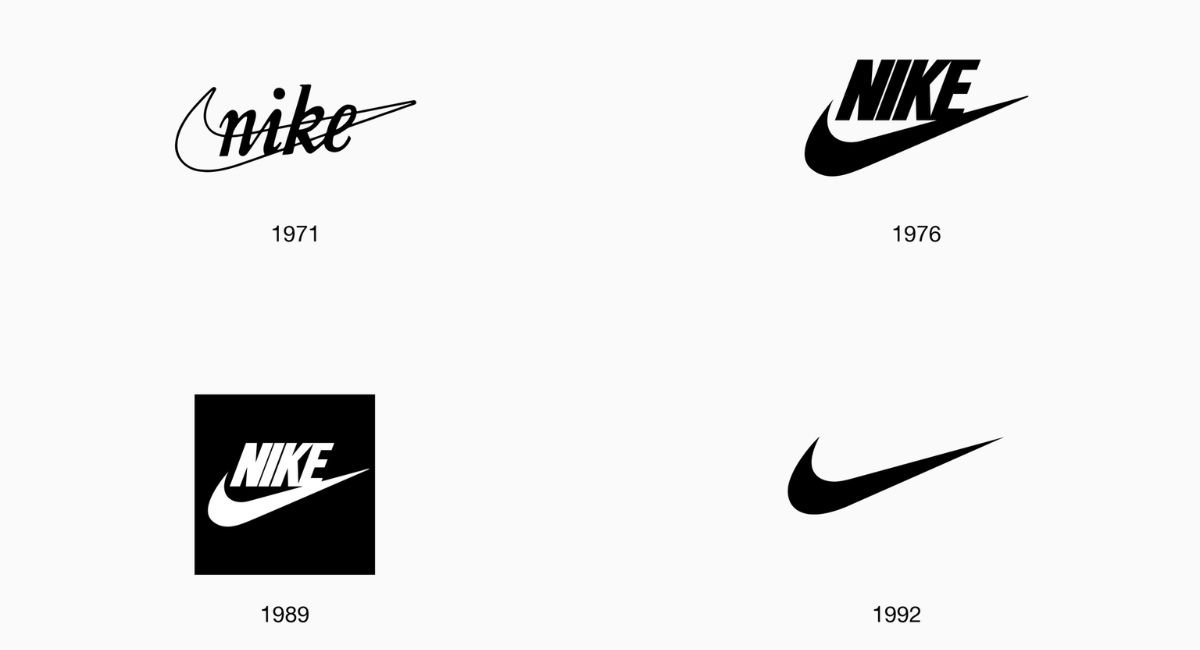
Over time, Nike simplified its branding and relied almost entirely on the Swoosh, eventually removing the word “Nike” from the logo. This showed the symbol was strong enough to stand alone. Inspired by the wing of the Greek goddess Nike, the Swoosh came to represent not just a brand but movement, determination, and achievement.
Why the Swoosh Endures
The success of the Nike logo is not rooted in complexity but in clarity. It works because it is the following:
- Simple enough to be instantly recognizable
- Flexible across shoes, apparel, and digital media
- Emotionally tied to ideas of motion and progress
- Consistently reinforced through sport and storytelling
Combined with Nike’s broader identity and messaging, especially the famous “Just Do It” philosophy, the Swoosh became more than a design. It became a mindset.
What began as a student’s sketch for a struggling company is now one of the world’s most recognisable symbols. The Swoosh appears on everything from Olympic gear to everyday shoes, always representing movement and progress. Ultimately, the Nike logo is more than design; it’s proof that a simple idea, with the right timing and belief, can become iconic.