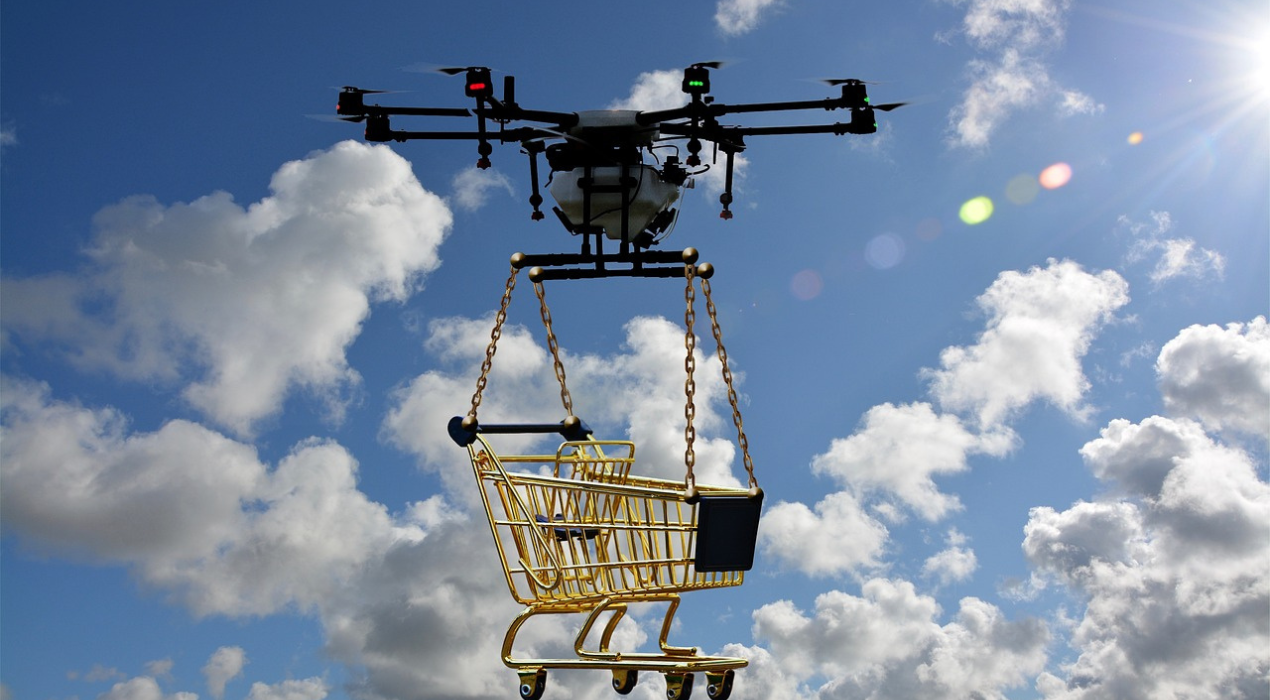
Unmanned aircraft systems, commonly known as drones, are becoming increasingly popular in modern logistics operations. Medicines, packages, groceries, food, and other household goods are all carried by delivery drones. Due to their accuracy, environment-friendly operations, short delivery times, and lower operational costs than traditional delivery channels, these drone delivery services are gaining widespread traction in last-mile delivery. Analysts estimate that the operating costs of a drone delivery service range from 40% to 70% lower than those of a vehicle delivery service model. Additionally, the COVID-19 pandemic has made it even more urgent to seek out safer, contactless delivery methods. The global demand for drone delivery services has increased as a result.
What is a drone delivery?
Drones are uncrewed aerial vehicles (UAVs) that can be controlled remotely or fly autonomously using software and sensors. They are flying robots that can do a lot of different things without a human pilot on board, like military reconnaissance and surveillance or commercial tasks like taking pictures, delivering packages, and inspecting infrastructure. The use of unmanned aerial vehicles (UAVs) to transport goods—such as small parcels, medical supplies, food, and so on—from a distribution hub (or store) to a destination without the use of a traditional delivery vehicle is what is meant by the term “drone delivery.” The pilot or operator is not directly watching the drone while it is in flight, which is known as “Beyond Visual Line of Sight” (BVLOS). Types of goods vary: lightweight parcels, urgent medical items, food-deliveries, or specialised logistics in hard-to-reach places. The goal is to reduce emissions, speed up deliveries, and cut costs—especially in the last mile.
How Drones Delivery Works?
Drone delivery appears to combine logistics automation, AI navigation, and aviation engineering.
1. The Parts of the System
A drone is an unmanned aerial vehicle (UAV) that can carry payloads of 2 to 10 kilograms and is powered by lithium-polymer batteries.
Navigation & Sensors: GPS, LiDAR, cameras, and ultrasonic sensors guide precise take-offs, routes, and landings.
Ground Control: Operators or AI systems monitor flights from centralized control rooms, often Beyond Visual Line of Sight (BVLOS).
Delivery Method: Some drones drop packages using a tether, while others briefly land on pads or “drone-ports” that have been designated.
2. Flight Operations
Packages are loaded at a micro-fulfillment center.
The autonomous drone travels to the drop-off location by calculating the safest and shortest route while avoiding no-fly zones. It returns or swaps batteries at a charging dock following delivery, preparing for the subsequent flight.
Benefits of Drones Delivery: How they can change everything
1. Efficiency and rapidity: Drones bypass traffic and reach destinations in minutes. Small parcels may soon receive deliveries on the same day or even within 15 minutes.
2. Environmental Impact: The last-mile emissions of fully electric drones can be reduced by up to 70% in some models, making them significantly less harmful than delivery vans.
3. Life-Saving Accessibility: In emergencies or disasters, drones deliver blood, vaccines, and equipment to isolated areas. Both India’s i-Drone project and Africa’s zipline have demonstrated their humanitarian value.
4. Cost Reduction: Once scaled, drones can lower last-mile delivery costs (the most expensive segment of logistics) by eliminating drivers, fuel, and idle time.
5. Reduced Road Congestion: By removing thousands of short urban van trips, cities enjoy smoother traffic flow and lower noise pollution.
The Challenges of the Drones Delivery
- Control of Airspace and Regulation
Governments must define safe altitude corridors, licensing, and BVLOS permissions.
- Security and Dependability
Redundancy systems are absolutely necessary because drone failures, collisions, and package drops all present a risk.
- Battery & Payload Limits
Current battery tech restricts range (10–25 km) and weight (< 5 kg for most commercial drones).
- Public Acceptance & Privacy
Citizens are concerned about noise, concerns about surveillance, and the sight of low-flying drones.
- Infrastructure Requirements
Drone-ports, charging hubs, and rooftop landing zones are still rare.
- Geography & Weather
India’s monsoons, fog, and strong winds make things especially difficult.
Despite these hurdles, rapid innovation in battery efficiency, AI-based collision avoidance, and regulatory sandboxing is paving the way.
The Current State of Drone Delivery
The industry of drone delivery is already in the air:
- In 2022, McKinsey & Company estimates that there will be nearly 900,000 commercial drone deliveries, up from less than half a million the year before.
- Major players include: Zipline, Wing (Alphabet), and Amazon, all of which have delivered thousands of packages successfully.
- India’s progress: The Indian Council of Medical Research’s i-Drone initiative has delivered over 17,000 vaccines and medical supplies to remote Northeast regions.
- Retail pilots: Walmart and FedEx are experimenting with urban drone drops, while Indian startups like Garuda Aerospace and TechEagle are running food and medicine pilots.
Drone delivery is no longer experimental — it’s transitioning from novelty to necessity.
The Future of Drone Delivery
- Complete Autonomy Drones: powered by AI will manage intricate urban navigation and traffic coordination with the least amount of human intervention.
- Swarm and Networked Drones: Multiple drones operating as intelligent fleets — sharing data, routes, and battery resources in real time.
- Integration of Smart Cities: Within the context of smart-city ecosystems, urban planners are creating “drone highways” and rooftop landing pads.
- Expanded Payloads: Lightweight materials and battery density advancements will make it possible to transport heavier items like groceries, electronics, or parts for furniture.
- 5G and 6G Connectivity: Real-time air traffic management, precise routing, and live streaming of safety data will all be possible thanks to ultra-low latency networks.
By 2030, analysts predict that urban drone deliveries could exceed 10 million annually worldwide.
Impacts on Business and Public Policy:
- For Companies E-commerce and retail: Use drones to speed up the delivery of small packages. Healthcare: Deploy medical drones for emergency logistics. Make investments in hybrid delivery models and drone-port infrastructure, logistics companies.
- For Governments & Policymakers: Create digital systems for controlling air traffic at low altitudes. To encourage safe testing, provide regulatory sandboxes.
- For Investors & Startups: Concentrate on enabling technologies like AI routing, BVLOS safety systems, batteries, and software for fleet management.
The global drone-delivery market could exceed USD 50 billion by 2030, creating a vast opportunity frontier.
Drone delivery sits at the intersection of necessity and innovation. As e-commerce booms, cities congest, and sustainability targets tighten, taking to the air is no longer optional — it’s inevitable. The journey ahead will involve trial, regulation, and technological refinement. But when all pieces align, drones will not only carry our parcels; they’ll carry an entirely new vision of connected, carbon-smart cities.
The use of drone technology and drones for delivery is inevitable. Soon, multiple industries will leverage drone technology to bring innovation to their business areas, including surveillance, research, last-mile delivery, etc. E-commerce giants have been at the helm of research, development, and filing patents in drone technology since 2005. They are still investing in this area and are focusing on lowering the cost of last-mile delivery operations, reducing delivery times, and integrating drone technology with mobile phone applications to improve user experiences. Drone delivery services will only grow in the coming years, and companies will need to stay invested in drone delivery programs and technology enhancements before realizing operational growth and cost benefits.