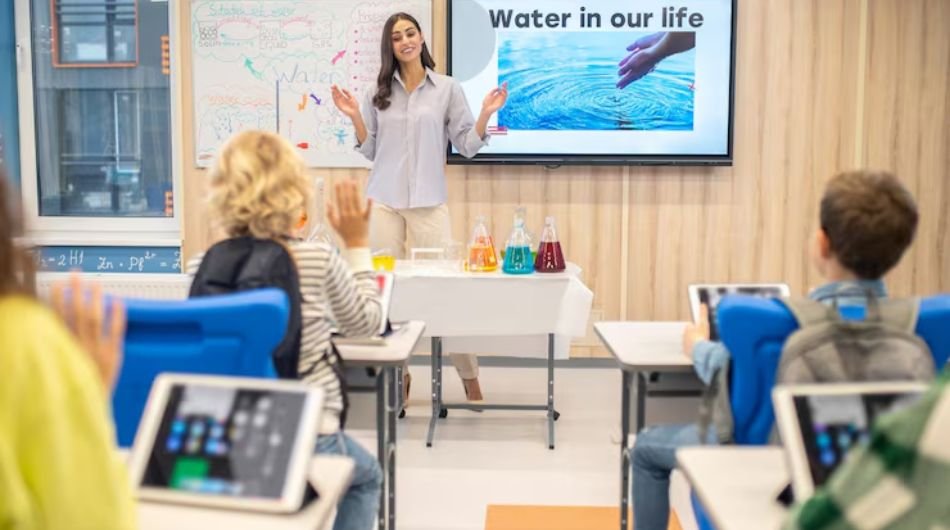
In today’s fast-evolving digital era, education is no longer confined to textbooks and chalkboards. Schools, especially ICSE institutions across India, are embracing smart classrooms and digital tools to create learning environments that are interactive, inclusive, and future-ready. This transformation is not just about adding technology; it represents a fundamental shift in how students learn and how teachers teach.
At institutions like Rays, technology is deeply integrated into everyday learning. From interactive whiteboards to AI-powered platforms, digital tools are helping students understand complex concepts with greater clarity, confidence, and curiosity.
What Is a Smart Classroom?
A smart classroom is a technology-enabled learning space where traditional teaching methods are enhanced or replaced by digital tools such as smart boards, multimedia systems, and online platforms. Instead of passive listening, students engage with visual content like animations, videos, and simulations.
Shift from Traditional to Smart Learning
Traditional classrooms are typically teacher-centred, relying on lectures, note-taking, and memorisation. While effective for foundational learning, they often limit interaction and creativity.
Smart classrooms, on the other hand, promote a student-centred approach. Learning becomes dynamic, participatory, and collaborative. Students interact with content, ask questions, and engage in hands-on activities leading to deeper understanding and better academic outcomes.
How Digital Tools Enhance the Curriculum
Digital tools align perfectly with the curriculum’s focus on application-based learning and critical thinking. They enhance education in several ways:
- Interactive Content: Games, quizzes, and simulations make learning engaging and reinforce concepts.
- Online Learning Portals: Students can revisit lessons anytime, enabling continuous learning.
- Performance Tracking: Teachers can monitor progress and tailor lessons to individual needs.
- Global Access: Students gain exposure to worldwide knowledge and real-time information.
Role of Smart Boards in Learning
- Smart boards have become the centrepiece of modern classrooms. Unlike traditional boards, they allow teachers to display multimedia content, annotate diagrams, and create interactive lessons.
- For instance, a biology teacher can present a 3D model of a cell, enabling students to explore its structure in detail. In mathematics, abstract concepts can be visualised step by step, making them easier to grasp.
- Smart boards also encourage participation. Students can solve problems directly on the screen, fostering confidence, collaboration, and critical thinking, essential skills for ICSE learners.
Improving Teacher–Student Interaction
Contrary to the belief that technology reduces human interaction, it actually strengthens it. Digital tools enable better communication and personalised attention.
Through Learning Management Systems (LMS) and classroom apps:
- Teachers can assign tasks and provide instant feedback.
- Student progress can be tracked in real time.
- Lessons can be customised based on individual learning needs.
Digital Platforms for Homework and Assessment
Homework and assessments have evolved significantly with digital platforms. Traditional methods are being replaced by smarter, more efficient systems.
Key benefits include the following:
- Instant Feedback: Students quickly learn from mistakes.
- Personalised Tasks: AI suggests exercises based on performance.
- Paperless Submissions: Promotes eco-friendly practices.
- Parental Access: Parents can track progress and stay involved.
Encouraging Creativity and Collaboration
Digital tools have opened new avenues for creativity and teamwork. Students can create presentations, collaborate on projects, and share ideas through cloud-based platforms. From coding programs to digital art tools and virtual labs, technology encourages:
- Critical thinking
- Problem-solving
- Communication skills
Challenges in Implementing Smart Classrooms
Despite their benefits, smart classrooms come with challenges:
- High setup costs for infrastructure and devices
- Need for teacher training and adaptation
- Dependence on reliable internet connectivity
- Concerns about data privacy and digital safety
The Future of Digital Learning
The future of education is undoubtedly digital. Emerging technologies like Artificial Intelligence (AI), Virtual Reality (VR), and Augmented Reality (AR) are set to redefine classroom experiences.
Soon, students may:
- Explore historical sites through VR
- Conduct experiments in virtual labs
- Receive AI-driven personalized learning paths
These innovations will shift the focus from rote memorisation to experiential learning, preparing students for a rapidly changing world.