The COVID-19 pandemic permanently reshaped how people shop. What was once a primarily in-store experience has shifted dramatically toward digital platforms. Today, online discovery drives most purchasing decisions. Studies show that nearly 63% of the shopping journey begins online, even if the final purchase happens in a physical store. While this digital shift has unlocked convenience and accessibility, it has also introduced new challenges, especially around product uncertainty and high return rates.
This is where Augmented Reality (AR) and Virtual Reality (VR) are stepping in to redefine the retail experience. Through immersive “try-before-you-buy” solutions, these technologies are bridging the gap between physical and digital shopping, offering consumers a more confident, interactive, and personalised way to shop.
Despite its convenience, online shopping lacks one critical advantage of physical stores: the ability to experience products firsthand. Shoppers cannot try on clothes, test makeup, or visualise furniture in their homes before purchasing. This often leads to hesitation, dissatisfaction, and ultimately, returns.
Return rates highlight the scale of the issue:
- Clothing return rates can reach as high as 23%
- Online returns are three times higher than in-store returns
- Retailers lose approximately $15 for every $100 spent online
A common behaviour known as “bracketing” worsens the problem. Customers order multiple versions of the same product, in different sizes, colours, or styles, intending to keep only one. In fact, about 31% of consumers engage in this practice when unsure about sizing.
Beyond financial losses, returns also carry environmental consequences. Millions of returned items end up in landfills, contributing significantly to carbon emissions and waste.
Enter AR/VR: The “Try Before You Buy” Revolution
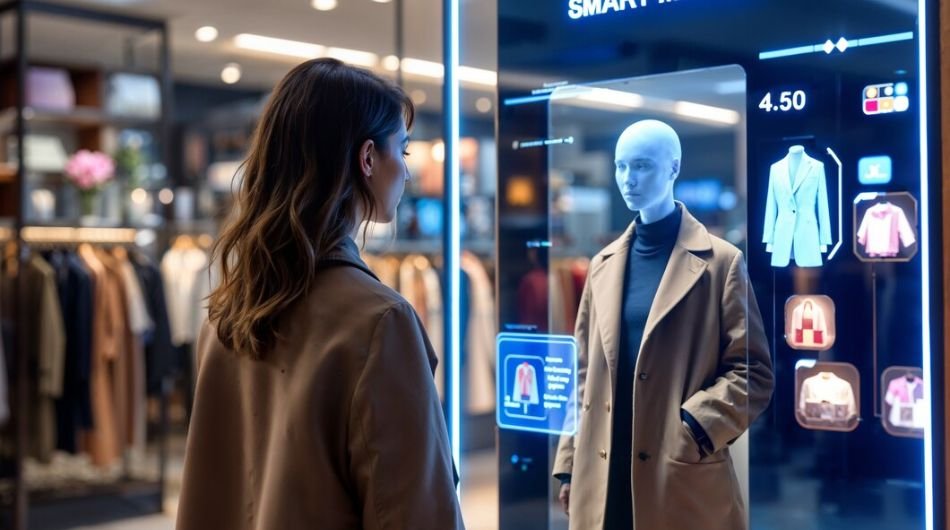
Augmented reality and virtual reality are transforming e-commerce by offering interactive, real-time product experiences. Virtual try-on solutions allow customers to preview products using their device camera, whether it’s trying on sunglasses, testing lipstick shades, or placing a sofa in their living room.
Unlike static images, AR creates dynamic, responsive experiences:
- Products move and adjust in real time
- Users can view items from multiple angles
- Visualization occurs in the user’s actual environment or on their body
How AR Virtual Try-On Works
Behind the seamless experience lies a powerful combination of advanced technologies:
1. Computer Vision
Computer vision enables systems to detect and track faces, bodies, and physical spaces. It ensures that virtual products align accurately with the user’s movements, creating realistic overlays.
2. Real-Time Rendering and Object Tracking
As users move, the system continuously updates the position and appearance of the product, maintaining a natural and believable experience.
3. Natural Language Processing (NLP)
Voice-enabled features allow users to interact with virtual assistants, receive recommendations, or navigate the experience using simple commands, making it more accessible and intuitive.
4. Machine Learning (ML)
ML algorithms personalise the experience by analysing user behaviour, preferences, and interactions. They also improve accuracy in sizing, recommendations, and product matching over time.
Key Components of a Successful Virtual Try-On Experience
For AR shopping to be effective, several elements must work together:
- High-quality 3D models that closely resemble real product
- Accurate sizing and alignment to build trust
- Cross-device compatibility for accessibility
- Fast performance to avoid lag and frustration
- Seamless integration with product pages and checkout
- Analytics tools to track user behavior and optimize experiences
Benefits for Businesses and Consumers
- For Businesses
- Higher conversion rates due to increased confidence
- Reduced return rates and lower logistics costs
- Improved customer engagement and retention
- Stronger brand differentiation in competitive markets
- Data-driven insights for better decision-making
- For Consumers
- Convenience: Try products from anywhere
- Confidence: Make informed purchase decisions
- Speed: Faster decision-making
- Enjoyment: Interactive and engaging shopping
- Accuracy: Fewer sizing and style mistakes
In the next 5–10 years, AR and VR will become standard in e-commerce, not just optional features. With deeper AI integration, more affordable devices, and better smartphones, shopping experiences will become highly personalised and widely accessible. Retail will also shift toward hybrid models that blend online and in-store interactions while expanding into emerging markets. Ultimately, AR and VR will move from enhancing shopping to defining how people shop.