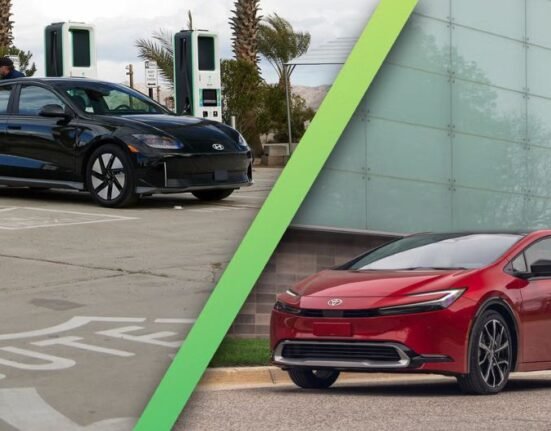
A passenger car known as an electric car or an electric vehicle (EV) uses electrical energy as its primary means of propulsion and is propelled by an electric traction motor. The term typically refers to a battery electric vehicle (BEV), which only makes use of energy stored in onboard battery packs. However, it can also refer to plug-in hybrid electric vehicles (PHEVs), range-extended electric vehicles (REEVs), and fuel cell electric vehicles (FCEVs), which can use a generator or fuel cell to convert electric power from other fuels.
Even when a fossil-fuel power plant supplies the electricity, electric cars are typically associated with a lower overall carbon footprint from manufacturing to end of life, in addition to being quieter, more responsive, having superior energy conversion efficiency, and emitting no exhaust emissions. Electric cars also produce less waste heat because their motors are more efficient. This makes it less necessary to use engine cooling systems in ICE vehicles, which are typically large, complicated, and time-consuming to maintain.
In 2023, there were 14 million plug-in electric cars sold worldwide, or 18 percent of new car sales, up from 14 percent in 2022. To reduce air pollution and limit climate change, numerous nations have legislated to phase out the sale of fossil fuel vehicles, while others have established tax credits, subsidies, and other non-monetary incentives for plug-in electric vehicles. EVs are expected to account for over one-fifth of global car sales in upcoming years.
As a result, the businesses leading this change are very interesting to investors, policymakers, industry observers, and car buyers alike. We examine ten of the most significant EV car manufacturers worldwide, examining their positions, offerings, and significance.
Top 10 Manufacturers of EV Cars
1.BYD Company [China]
With its headquarters in Shenzhen, China, BYD (Build Your Dreams) has emerged as a global EV powerhouse. It is anticipated to continue expanding significantly and will sell over 4 million vehicles—including hybrids and fully electric vehicles—in 2024.
Strengths:
- Complete vertical integration—the company manufactures its own automobiles, chips, and batteries.
- A wide range of models, from budget city cars to high-end sedans and buses.
- Strong domestic sales network and rapid international expansion (Europe and Latin America).
Challenges:
- Profit margins are thinner than Western rivals due to aggressive pricing.
- Issues with perception in foreign markets as a result of tariffs and trade barriers.
- A significant reliance on the market in China; geopolitical risk if export restrictions are imposed.
2.Tesla, Inc [United States]
Tesla is still a major player in the EV market. It was the best‐selling battery-electric-vehicle (BEV) manufacturer globally in recent years. Founded by Elon Musk in 2003, Tesla revolutionized the automotive industry by proving that EVs can be high-performance, desirable, and profitable. It is still the global standard for software-driven vehicles and innovation.
Strengths:
- Industry-leading software ecosystem (Autopilot, OTA updates).
- battery technology with high efficiency and a massive global charging infrastructure.
- Strong brand loyalty and an advantage as an early adopter.
Challenges:
- Increasing the level of competition from traditional and Chinese automakers.
- Quality-control issues and negative press around customer service.
- High dependence on Elon Musk’s public image and decision-making volatility.
3.Volkswagen Group [Germany]
According to unit-sales data it reached around 744,800 EV units in 2024. When it comes to the businesses’ transitions from ICE vehicle ranges to all-electric ones, the traditional German OEM is leading the way among all heritage car companies. Volkswagen is well on its way to becoming entirely electric. As the primary transition partner for Addison Lee, the company has also attracted the attention of one of London’s most prestigious fleet businesses. The company is currently reducing production of its ICE vehicles to make room for more EVs.
Strengths:
- Brand diversity and a global manufacturing footprint (VW, Audi, Porsche, and Skoda). Ability to invest billions in battery and electric vehicle technologies.
- Increasing market share in Europe and growing presence in China.
Challenges:
- Bureaucratic structure slows innovation and agility.
- The Cariad software division’s software delays and overruns.
- In Europe, competition from Chinese EVs at lower prices.
4.General Motors (United States)
GM, which was founded in 1908, has long been a representation of American automotive power. Today, it’s making a serious EV push through its Ultium platform and the electrification of iconic brands like Chevrolet, GMC, and Cadillac.
Strengths:
- Scalable Ultium battery system for a variety of models and brands.
- Strong government incentives and manufacturing presence in North America.
- Established brand trust and wide dealership network.
Challenges:
- Slow ramp-up of EV production and delivery.
- Concerns about profitability as it moves away from ICE vehicles.
- Needs to compete with tech-driven companies like Tesla and Rivian.
5.Hyundai Motor Company [South Korea]
Chinese firms seem to be at the forefront of innovation and Hyundai Motor Group is one OEM that has managed to successfully begin its transition to the electric side. With growing interest in its IONIQ models, the company achieved just 0.01% less than its upper rival—a market share of 3.96% of the BEV sector. Despite this, the company continues to offer exciting new products to customers all over the world and implements cost-cutting and battery density enhancements.
Strengths:
- Excellent EVs in terms of design, range, and construction (the Ioniq 5 and 6 have won global awards).
- Strong R&D capabilities and expanding partnerships for charging infrastructure.
- Competitive pricing and solid reliability reputation.
Challenges:
- Struggles to define a luxury EV identity under the Genesis brand.
- Relatively small presence in China’s fast-growing EV market.
- high costs for production and export.
6.BMW Group [Germany]
As BMW enters full swing in its EV transition, the concepts and new vehicles have been flying since the iX’s release. In the first quarter of 2023, the company’s efforts to expand its BMW and Mini EV ranges led to a market share of 4.16 percent; however, in the second quarter of 2023, the company doubled its sales of all-electric vehicles. The BMW brand saw a 5% year-over-year increase in quarterly sales, while the Mini brand only saw a 0.2 percent year-over-year increase in quarterly sales.
Strengths:
- A solid reputation for engineering and a luxury brand.
- Focus on driving experience and efficiency.
- Advanced battery and vehicle architecture for future scalability.
Challenges:
- Compared to other premium EV players, transition speed is slower.
- Expensive models limit accessibility.
- Fierce competition from Tesla, Mercedes EQ, and Audi e-tron.
7.Stellantis N.V. (Global – Netherlands HQ)
Stellantis is a multinational powerhouse that manages brands like Jeep, Peugeot, Fiat, and Citron. It was formed in 2021 as a result of the merger of Fiat Chrysler and PSA Group. It’s heavily investing in electrification through its “Dare Forward 2030” strategy.
Strengths:
- Global reach with a broad and diverse brand portfolio.
- Major EV platforms (STLA Medium, STLA Large) under development.
- Solid R&D investment in solid-state batteries and digital tech.
Challenges:
- Sluggish transition rate in comparison to rivals in Asia.
- Challenges in brand management and a complicated corporate structure needs software and digital ecosystems that are stronger.
8.Ford Motor Company [USA]
Ford has entered the EV market with vehicles like the Mustang Mach-E and the electric F-150 Lightning. The company is leveraging its legacy in trucks and SUVs to offer EV alternatives in popular segments while expanding its global EV presence.
Strengths:
- Strong global brand, especially in certain vehicle segments (trucks/SUVs) which could translate into EVs.
- Ability to leverage existing manufacturing and global supply networks.
Challenges:
- R&D, manufacturing, and the supply chain all need to be drastically altered if the ICE legacy is to be replaced by EVs.
- Price and technology play a significant role in the fierce competition for EVs.
9.Toyota Motor Corporation (Japan)
With the Prius, Toyota set the standard for hybrid vehicles and is gradually moving into EVs with all-battery systems. Hybrids, hydrogen fuel cells, and the creation of new electric vehicle models to compete globally while utilizing its extensive manufacturing expertise are at the center of its EV strategy.
Strengths:
- Huge scale, deep expertise in manufacturing, supply chain, and hybrid technology.
- Strong financials and brand credibility.
Challenges:
- Slower than some of its rivals to fully embrace pure battery electric vehicles (BEVs); risk of being viewed as behind in the BEV-only world.
- Must ramp up battery/EV investments, software and services to match more agile players.
10.NIO Inc. (China)
NIO is a premium EV startup based in China, focusing on smart, connected electric SUVs and sedans. The company emphasizes technology features like battery swapping, autonomous driving assistance, and subscription-based services, targeting urban and affluent buyers.
Strengths:
- Focused on innovation, connected car features, and subscription services as a premium EV brand.
- Growing brand in China, pivoting to exports.
Challenges:
- Still on a small scale in comparison to major incumbents; major obstacles include global expansion and profitability.
- Supply chain, raw materials, charging infrastructure beyond China remain big tasks.